
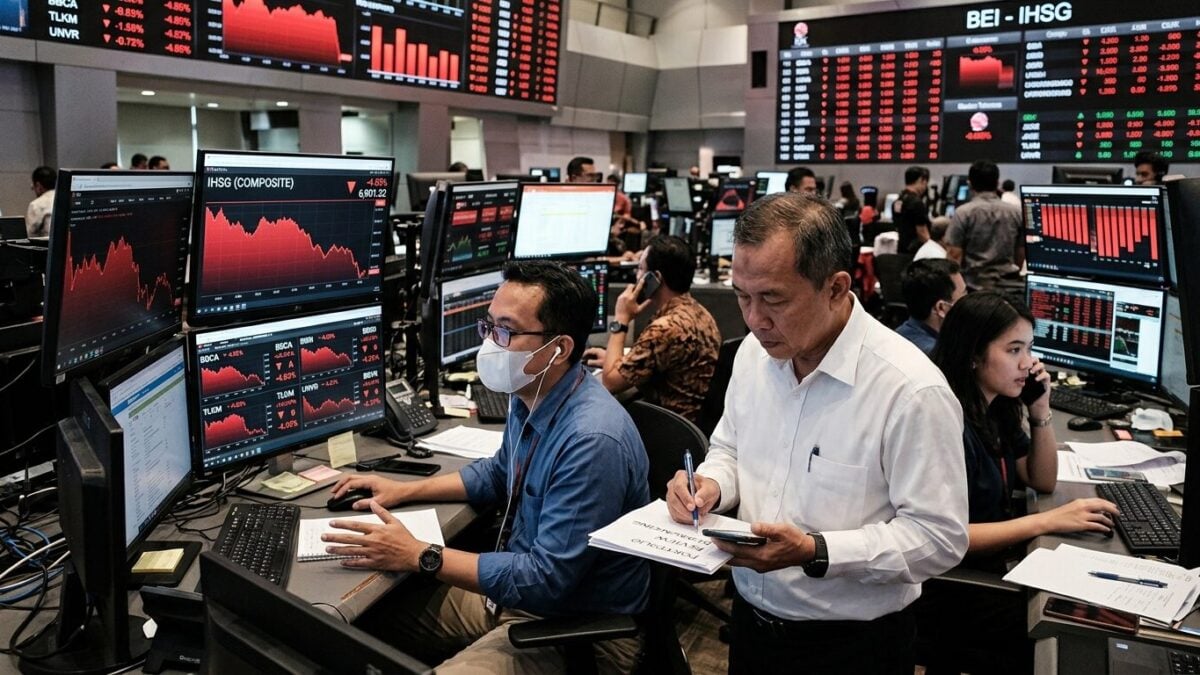
JOURNALARTA.COM, JAKARTA — Indonesia’s stock market turned volatile again at the end of the last trading week of June 2026. After briefly showing signs of recovery, the Jakarta Composite Index, or IHSG, suddenly reversed course. The sharp drop sent many retail investors scrambling to check their portfolios.
Based on trading data from the Indonesia Stock Exchange (IDX) at Friday’s close, June 26, 2026, the IHSG fell 1.72 percent, or 102.9 points, to 5,896.13. For the week, the benchmark lost 3.58 percent from the opening level of 6,116.69.
What triggered the slide? And what should investors do now so their holdings do not erode further? Here is the breakdown.
Why the IHSG sank at the end of June 2026
The drop below 5,900 was driven by a mix of external and domestic pressure. Globally, heavy selling in semiconductor stocks on Wall Street spilled into Asian markets and dragged down local sector indices.
Rupiah swings also weighed on sentiment. As the exchange rate kept moving against the U.S. dollar, foreign investors tended to stay on the sidelines and lock in profits instead of adding fresh positions.
That kind of screen can sting. Fast.
Still, panic is usually the most expensive response in a market downturn. Investors who react blindly often end up selling at the worst possible time.
For holders who see their portfolios turning deep red, the first step is not to rush for the sell button. It is to check what they actually own.
1. Audit your portfolio first
When the IHSG falls hard, almost every stock gets dragged lower by market psychology. That makes it the right time to separate weak names from resilient ones.
Check the fundamentals: Look at whether the price drop comes with weaker company performance, or whether it is mainly a broad market correction.
Keep quality stocks: If you hold large-cap blue chips with solid fundamentals and regular dividends, the decline may only be temporary. These stocks often rebound fastest when sentiment improves.
2. Keep cash ready for buy on weakness
For disciplined investors, a deep correction can create a chance to buy good stocks at lower prices. A market slide often turns strong companies into temporary discounts.
Do not use all your cash at once. A better approach is to buy in stages, or average down, near strong support levels.
Focus on sectors that tend to hold up better in rough markets, or on names supported by broader efforts to improve banking liquidity in Indonesia.
3. Review stop loss levels and protect your mindset
For short-term traders, discipline decides whether capital survives a volatile session.
Follow the trading plan: If a stock breaks the stop loss level or a key support line set earlier, cut risk without hesitation so losses do not pile up for too long.
Step away from the screen: Watching every tick during a selloff can fuel stress and trigger panic selling. Give yourself space to think clearly.
A cold head matters more than a fast finger.
What this means for investors
The move to 5,896.13 fits the usual cycle of a market correction. History shows the IHSG has recovered after bouts of heavy selling and gone on to set new highs later on.
The next move will depend on whether global risk appetite improves and whether domestic sentiment steadies. For now, investors who stay calm, review their holdings, and manage cash carefully are better placed for the rebound when it comes.
Quick take: first audit the portfolio, then keep some cash ready, and always stick to risk limits. Those three steps can make a rough week easier to handle.
🔥 Trending Now
HOTSports
Complete 2026 World Cup Bracket: New 48-Team Format From Group Stage to Final
HOTEntertainment
TVRI Sport Live Streaming for World Cup 2026: Official, Free Access
HOTKeamanan Digital
5 Apps to Watch the 2026 World Cup Free on Your Phone Without Buffering, Official & Legal
HOTSports

📝 Leave a Comment
Comment as . Reviewed by an admin before it appears.