Google Gemini Expands Beyond Chatbots Into Robots and Car Dashboards
Google's Gemini AI is moving from phones into physical systems. The company released Gemini Robotics 2, enabling robots to perform complex tasks autonomously…
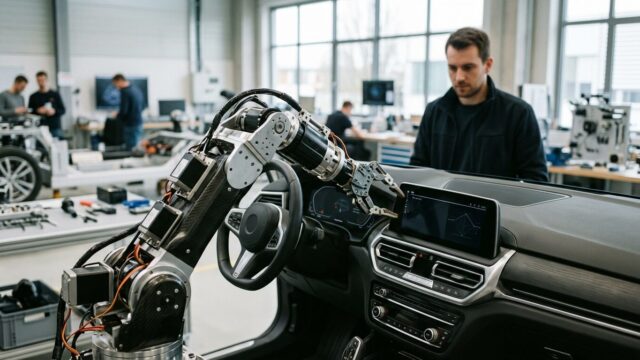
Google DeepMind released a new version of Gemini that can control humanoid robots, marking a significant shift in how the AI giant is deploying its models beyond digital interfaces. The system, called Gemini Robotics 2, combines vision language models with action-control systems to allow robots to perform complex physical tasks—screwing lightbulbs, organizing shelves, tying trash bags—without human intervention for each step.
The robotics move comes as General Motors begins rolling out Gemini in millions of vehicles, with plans to launch a deeper proprietary AI assistant later this year. GM's expanded automotive AI system will integrate vehicle telemetry and predictive maintenance data, capabilities that the general-purpose Gemini cannot match on its own.
How Gemini Controls Robots
Gemini Robotics 2 layers multiple AI systems. A vision language model processes images and video to understand a robot's surroundings and reason about tasks. Two separate vision language action models handle full-body movement and hand or gripper control. Google DeepMind trained the combined model using human teleoperation, video examples, and simulations—current AI systems still require task-specific training rather than learning entirely on their own.
In public demonstrations, robots from companies like Apptronik performed shelf tidying and other dexterous work autonomously. "It's another milestone in our path towards really getting towards what we call like physical AGI, which means we get a robot to do anything that a human can," Carolina Parada, head of robotics at Google DeepMind, told WIRED.
The push into physical systems reflects Google's robotics history. The company previously partnered with Boston Dynamics to provide AI brains for legged robots, and has published foundational research on training AI for robotic control. Competitors like Anthropic and OpenAI have focused on chatbots and coding tools, but Google is betting AI's full potential requires breaking free from the digital realm.
Gemini in Cars: Broader but Less Integrated
General Motors launched Gemini AI in vehicles starting last year, with rollout to millions of 2022 model-year cars and newer underway. The system allows natural speech input—drivers no longer need to memorize commands—and can control vehicle features like temperature and radio. Recent updates added "live sessions" where the AI speaks conversationally or plays games like trivia.
But GM is not stopping there. Anna Santos, the company's director of product management for voice and AI, told CNBC that a new proprietary GM AI assistant launching later this year will integrate directly with vehicle telemetry, OnStar intelligence, and predictive maintenance. "This is the beginning," Santos said, describing the native assistant as far more tailored to automotive use cases than a general-purpose chatbot.
"With Gemini, customers can speak naturally," Santos explained, "but the new system combines conversational AI with GM vehicle knowledge to create capabilities that go beyond what a general purpose assistant can do." The company has not disclosed the name or the underlying language model provider for its proprietary system.
Enterprise Gemini Deepens Oracle Partnership
Beyond robotics and vehicles, Google is embedding Gemini into enterprise software. In July 2026, Oracle and Google Cloud expanded a partnership to bring Gemini models into Oracle's Fusion Applications, NetSuite, and AI Agent Studio—tightening integration between Oracle's business software and generative AI tools across its portfolio.
This built on an earlier April 2026 alliance linking Oracle's AI Database with Gemini via the Gemini Enterprise Agent Platform. The two moves create a unified AI stack inside Oracle's applications, strengthening adoption of AI-powered SaaS and cloud offerings among large enterprises. Yet investors remain focused on whether Oracle's heavy AI infrastructure spending translates into revenue growth, and whether customer adoption can offset competition from larger cloud providers.
The expansion across robots, automotive, and enterprise software shows Google betting that Gemini can anchor strategies across multiple industries—not merely competing with ChatGPT on a phone screen.