Google Drives Cloud Growth and Humanoid Robotics with Gemini AI
Google is shifting its focus toward enterprise services and physical automation. While Alphabet leverages Gemini AI to dominate cloud computing, Google…
MOUNTAIN VIEW — Google is expanding the reach of its proprietary artificial intelligence, leveraging gemini ai to secure major enterprise cloud contracts while pushing the software to control physical humanoid robots. The Silicon Valley giant recently showcased the commercial scale of its technology across multiple business fronts, even as the company navigates a transition in its research leadership.
Alphabet CEO Sundar Pichai said during a recent earnings call that 90% of Fortune 100 companies now use Gemini Enterprise. This corporate adoption helped drive an 82% revenue growth in Google Cloud during the second quarter. The surge in cloud business has strengthened Google's financial position as it competes against rival offerings from Microsoft and Amazon.
From Cloud Software to Physical Robotics
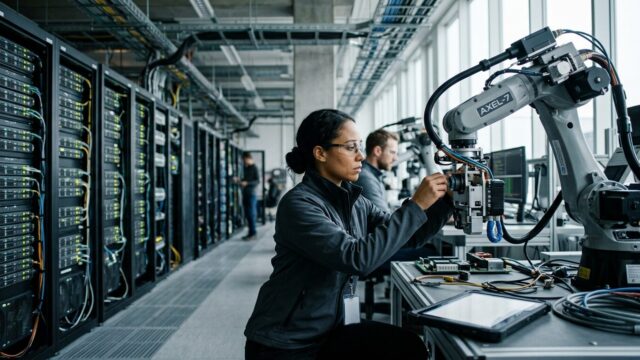
While Google secures its footing in enterprise software, the company is also attempting to break its models out of the digital realm. Google DeepMind recently released Gemini Robotics 2, a unified system that combines several artificial intelligence models to control physical robots, including advanced humanoid machines.
The system is capable of directing robots to perform dextrous, complex tasks such as tying trash bags and screwing in lightbulbs. The framework utilizes a vision language model to analyze images, video, and human instructions, alongside two vision language action models trained to manage spatial movement and the manipulation of robotic grippers or hands.
In video demonstrations, Google showcased Apptronik's Apollo 2 robot using specialized hands from Sharpa to tidy shelves. Google DeepMind trained the underlying system using a combination of human teleoperation, video examples, and digital simulations. Carolina Parada, head of robotics at Google DeepMind, stated that the release represents a milestone toward physical artificial general intelligence, with the ultimate goal of getting a robot to perform any physical task a human can.
Enterprise Demands and Reorganization
This dual push into cloud software and advanced robotics comes during an internal reorganization. Google recently experienced a shakeup in its core AI department, marked by the departure of chief scientist Jeff Dean after 27 years with the firm. Demis Hassabis has also moved away from the daily management of DeepMind.
These leadership changes highlight the friction between costly, long-term frontier research and the immediate commercial demands of the market. Building state-of-the-art models requires massive capital expenditure for computing power. Meanwhile, current business needs are often satisfied by existing, highly efficient systems.
Tomasz Tunguz, founder of Theory Ventures, observed that top-of-the-line frontier models are not always necessary to meet standard enterprise demand. Tunguz noted that for most white-collar workflows, reasonable and efficient models are already good enough, suggesting that the next generation of hyper-advanced models may find their primary utility in highly specialized computing domains rather than standard office tasks.
The Model Ecosystem
Google continues to distribute its underlying models across a wide range of platforms to maintain its market footprint. The company's current lineup includes several tiers, ranging from the lightweight, cost-effective Flash variants to high-compute Pro and Ultra versions designed for complex reasoning.
Google released Gemini 3.6 Flash and 3.5 Flash-Lite in July 2026, alongside an updated iOS application on August 5, 2026. These models are designed with extended context windows, allowing them to process massive datasets, entire software codebases, and long-form video files within a single user prompt.