China Funding Claims Cast Shadow Over Pro-Palestinian Marches in Britain
Claims that Chinese-linked money is helping drive pro-Palestinian marches in Britain are raising fresh questions about who is organizing anti-war activism — ...
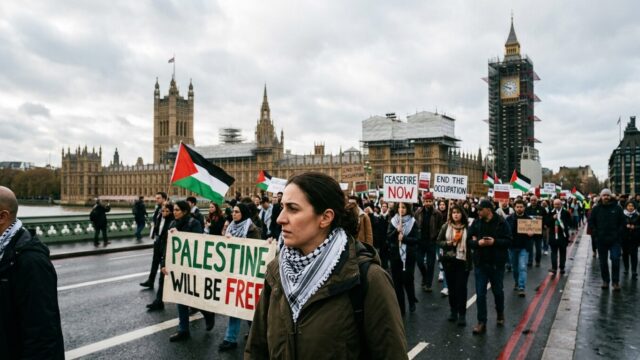
Claims that Chinese-linked money is helping drive pro-Palestinian marches in Britain are raising fresh questions about who is organizing anti-war activism — and why the same protest networks keep resurfacing around Gaza, Iran and even data centers. The allegations point to a wider pattern that analysts say stretches well beyond one issue.
The dispute has sharpened as reports and expert commentary describe overlapping activist coalitions that can mobilize fast, switch themes overnight and land in very different fights with one common thread: hostility toward the United States and its allies. That same machinery has been tied in recent reporting to protests in Washington over the Iran campaign, and to anti-Israel rallies in recent years.
From Gaza to Iran to data centers
Zineb Riboua, a fellow at the Hudson Institute, says anti-Americanism is increasingly binding together climate activists, anti-Israel protesters and other movements that once looked separate. She pointed to a 2024 rally in New York City where climate activists stood alongside anti-Israel protesters under the banner “Climate Justice Means Free Palestine.”
Last year, Greta Thunberg tried to reach Israel by sea on a Gaza protest flotilla and shouted “Free! Free! Palestine!” when she was refused entry, according to the source material. The pattern, Riboua argued, is not random. It is converging. Fast.
And now the fight has spilled into tech. Last week, activists from CodePink circulated an Instagram video attacking a Utah data center project backed by investor Kevin O’Leary. The group had already spent time rallying for Iran and the Cuba Communist Party. Same faces. Different banner.
The money trail under scrutiny
At the center of the funding claims is Neville Roy Singham, an American-born tech tycoon living in Shanghai. Reporting cited in the source material says his name has come up in congressional scrutiny over a “dark money” network that allegedly funnels funds through donor-advised vehicles and shell companies rather than directly to protesters.
One report said the groups that rushed to organize anti-war demonstrations over the U.S.-Israel military campaign against Iran were the same organizations that have led anti-Israel protests in recent years. It also said those groups have been linked to activism around Iran-related protests.
The allegations have spread beyond one march or one city. A Network Contagion Research Institute report in May 2024 linked three conveners of the “Shut It Down For Palestine” coalition — including the ANSWER Coalition and The People’s Forum — to a web of financial, personal, personnel and ideological ties involving Singham and Jodie Evans, co-founder of CodePink.
Why the issue matters beyond Britain
For governments and security analysts, the concern is not just street protest. It is the speed of coordination and the overlap between causes that can be folded into broader geopolitical messaging. The source material describes that dynamic as a form of cognitive warfare.
That makes Britain relevant even when the protests are about Gaza. Demonstrations in one country can echo organizing methods, funding questions and political narratives first seen elsewhere. The picture is murky. But it is no longer local.
CodePink activists, the source material says, recently joined self-described Marxist groups outside the White House to protest U.S. military action in Iran. One Washington rally. One more data point. And, for investigators, one more reason to keep tracing the money.