Tributyrin improves river prawn survival in bacteria test
Researchers tested tributyrin in juvenile oriental river prawns fed a diet with less fishmeal. One supplemented group survived a bacterial challenge better than two control groups, while growth did not differ significantly across the six diets tested over eight weeks.
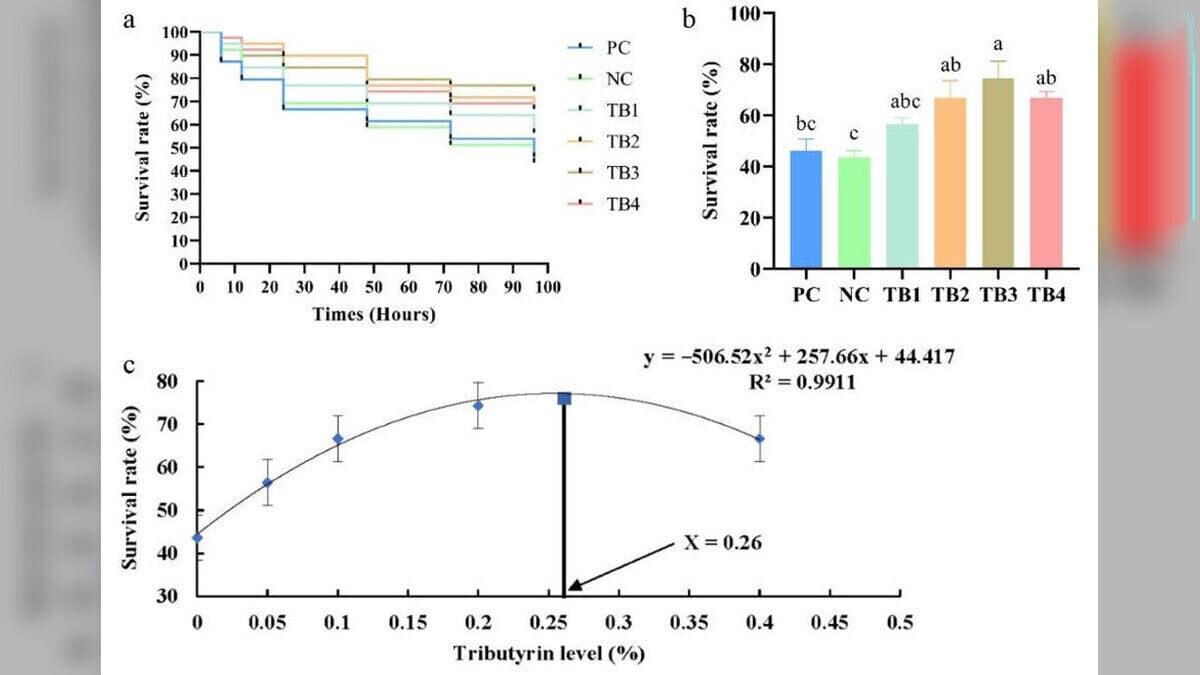
Chinese Academy of Fishery Sciences researchers found that tributyrin improved survival among oriental river prawns in a bacterial challenge after an eight-week feeding trial. The finding points to a possible supplement for prawn feed containing less fishmeal, an ingredient whose price can fluctuate.
Prawns fed a diet containing 0.20% tributyrin survived at a significantly higher rate after 96 hours than those in two control groups. The researchers exposed them to Vibrio cholerae bacteria in a separate challenge.
Xiaojun Jing and Bo Liu’s team published the study on October 8, 2026. The researchers tested 900 juvenile prawns across six diets, using three tanks of 50 prawns for each diet.
The reference diet contained 30% fishmeal and 22% soybean meal. A reduced-fishmeal control diet contained 25% fishmeal and 30% soybean meal without tributyrin.
Four other diets used the reduced-fishmeal formula with tributyrin at 0.05%, 0.10%, 0.20% or 0.40%. All six diets contained similar amounts of protein and fat.
Survival during the feeding period ranged from 86% to 92%. Differences in survival, weight gain and feed conversion were not statistically significant.
Fishmeal provides digestible protein and essential nutrients, but its changing price adds to aquaculture costs. Soybean meal can replace some fishmeal, though results vary by species and feed formulation.
At higher levels, naturally occurring compounds in soybean meal can interfere with nutrient use and may impair growth or immune function. Previous studies have linked tributyrin to better gut health in some farmed aquatic animals.
In the prawn trial, an intestinal enzyme that breaks down fats was more active at tributyrin levels of 0.10% to 0.40% than in either control group. Activity of an enzyme that breaks down starch was similar across diets.
Total antioxidant capacity in the prawns’ circulating fluid was higher at those same three supplement levels than in the unsupplemented reduced-fishmeal group. An enzyme that helps protect cells from oxidative damage was most active at 0.10% and 0.20%.
At those two levels, prawns also produced more messenger RNA for receptors that help recognize microbial threats than prawns in either control group.
A statistical model based on the bacterial challenge estimated peak survival at 0.26% tributyrin, between two tested levels. The researchers identified 0.20% as a starting point for farm trials and 0.26% as a level to test directly under commercial conditions.
 Take the quizWhat Kind of Holiday Spender Are You? Take the Black Friday QuizStart →





 Lifestyle · Food & HealthWhat Is Raynaud’s Syndrome? Why Fingers Turn White in the Cold
 Lifestyle · Food & Health4 Ways Walking After Meals Helps Your Body, Doctors Say
 Lifestyle · Food & Health4 Reasons to Eat Oatmeal, According to Nutrition Experts
 Lifestyle7 Signs Your Social Battery Is Running Low (and Why You Keep Cancelling Plans)