Asia Stocks Rally: Korean KOSPI Jumps 4.31% to 5,235.14
Asian markets climbed on Tuesday as South Korea and Japan led a technology rebound after Wall Street's biggest rally in about seven months. Oil prices fell further, but a looming US inflation report and an Nvidia board probe kept investors cautious.

The Asia stocks rally led by Korean chipmakers pushed South Korea's KOSPI index up 4.31% to 5,235.14 on Tuesday, November 10, as investors returned to technology shares that had been sold heavily last week.
Japan's Nikkei 225 gained 2.8% to 60,398. The broader MSCI Asia Pacific index climbed around 2%, and Japan's TOPIX advanced 2.2%.
Wall Street sets the tone
The gains followed Wall Street's best day in about seven months. The S&P 500 jumped 2.4% on Monday, its biggest daily advance since April, while the Nasdaq Composite rose 2.7% and the Nasdaq 100 gained 3.4%.
The Philadelphia Semiconductor Index surged nearly 7%. Last week's chip rout was partly driven by fears that Democratic gains in the US midterm elections could bring tighter regulation of the AI industry.
In Asian trade, Nasdaq 100 futures slipped 0.1% and S&P 500 futures rose 0.2%.
Taiwan steps in
Taiwan's Taiex surged as much as 6.4%, ending a seven-session slide that was its longest since 2022. Regulators had cut short-selling limits to 3% of 30-day average volume from 30%. They also raised margin requirements to 130% from 90% and kept a NT$500 billion ($15.2 billion) stabilization fund available.
Japan and Taiwan entered bear markets last week. Korea's index was more than 40% below its summer peak, and Taiwan's was 16% below its record. Samsung and SK Hynix had each lost more than 16%.
Oil falls, inflation data looms
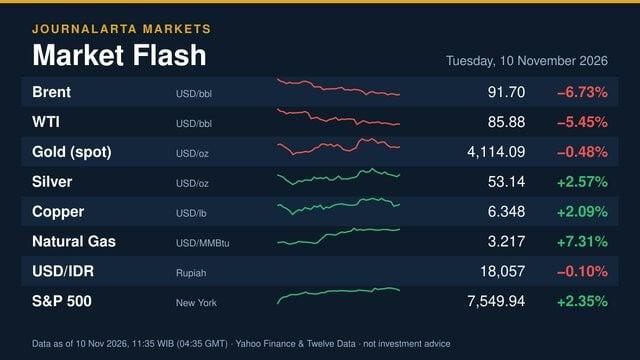
Brent crude traded at $91.56, down 1%, after a nearly 6% slide on Monday to an early-September low. US President Donald Trump said further strikes on Iran were unlikely if nuclear talks progressed, after he met Qatar's prime minister.
Lower oil eased worries about inflation. Still, October US consumer price data is due Tuesday, with headline and core prices forecast to rise 0.3% and 0.2%. Odds of a Federal Reserve rate hike climbed to 84% from 74% a week earlier after strong jobs data.
Nvidia fell 4.2% amid a board probe into possible foreign targeting of CEO Jensen Huang. Reports alleged links to a Chinese businesswoman suspected of passing information to Beijing. The board said it saw no evidence of compromised company secrets, and Nvidia reports earnings next week.
Other data across the region
China's October exports rose 35.2%, beating the 33.5% forecast but easing from September's 36.3%. Imports jumped 41.6%, above the 32% estimate. The trade surplus topped $1 trillion for a second year, supported by AI shipments.
Japan's household spending plunged 6.8% year-on-year in September, against a forecast 3.1% decline and the steepest drop since 2020. Markets expect the Bank of Japan to raise rates from 1.25% on December 18.
The ASX 200 in Australia rose 1.1%, Singapore's STI gained 1.6% and New Zealand's NZX 50 added 1%. In New Zealand's election count, around 400,000 special votes remain, with final results due November 27.
Anthropic launched Fable 5.2 and Mythos 5.2 ahead of a possible Tuesday IPO roadshow, seeking up to $69.3 billion. That listing and CoreWeave's results will test investor appetite for AI after hedge funds rapidly cut technology exposure.