Blaze Star Still Hasn’t Erupted, and Astronomers Can’t Say When It Will
Stargazers have waited two years for the Blaze Star, T Coronae Borealis, to flare into a nova. Astronomers say it will erupt, but the timing is hard to pin down. NASA's Elizabeth Hays would be a little surprised if it gets to 2030.
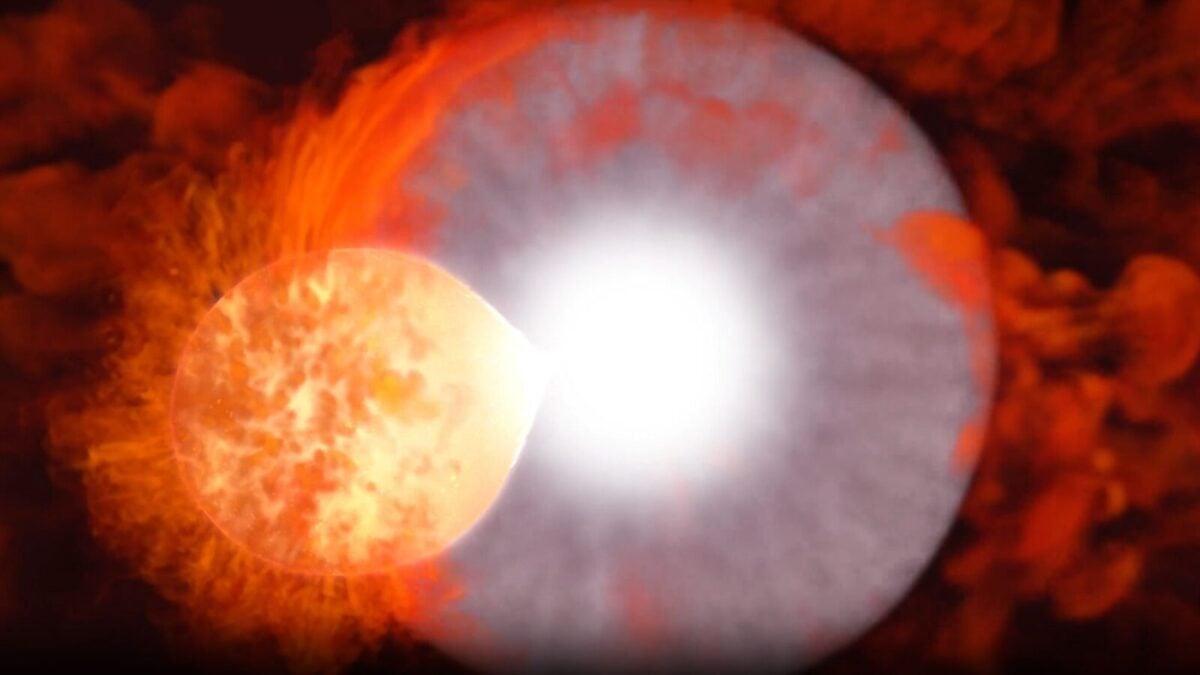
The Blaze Star, a double-star system formally called T Coronae Borealis, has still not erupted in the nova explosion stargazers have awaited for two years, and astronomers say the exact timing remains out of reach. Bradley Schaefer of the Louisiana State University Department of Physics and Astronomy is confident it will happen. "Everyone is very confident on this," he said in an email.
A nova is a sudden brightening, not the death of a star. For the Blaze Star, it would make a new point of light appear in the night sky.
What T Coronae Borealis is
T Coronae Borealis, or T CrB, is not one star. It is a binary system: a dense white dwarf paired with a bloated red giant.
Over roughly 80 years, the white dwarf's gravity pulls material off the red giant until it reaches a critical threshold. Then comes a nova explosion that makes the system flare to 1,000 times its usual brightness. It gradually settles, and the cycle starts again.
Why the date is hard to call
The last eruption reached Earth in 1946, so the system is well inside the window for another. The trouble is precision. Schaefer said astronomers cannot measure with high accuracy how fast gas is falling onto the white dwarf, or the exact trigger mass for the explosion.
"The exact date of the upcoming T CrB eruption depends primarily on how fast the gas coming from its companion star is accumulating on the surface of the white dwarf," Schaefer said. Astronomers know the gas has been piling up for 80 years and must be near the threshold.
Some researchers have compared a recent fluctuation in the system's light with a similar one before the 1946 event. Elizabeth Hays, lab chief at NASA's Astroparticle Physics Laboratory at the Goddard Spaceflight Center, said there have been dimming and brightening episodes that caused excitement but were not the main event.
"It is likely that the nova will happen in the next few years but we still don't know exactly when," Hays said. She would be "a little surprised" if it reached 2030, which is 84 years past the last eruption.
Hays said the red giant's glare outshines the dimmer white dwarf, which makes detailed observation difficult. Nor can astronomers precisely measure the temperature and pressure of matter near the smaller star's surface. "Predicting nova explosions are a little like predicting the weather," she said.
How the world will find out
There will be no visual warning before the light reaches Earth. Hays said there could be an early flash in the X-ray spectrum.
Amateur astronomers are watching the system closely. Schaefer said they monitor it roughly every minute or two. Once T CrB has brightened by around one magnitude, he said, "alerts will spread around the world within minutes."
 Take the quizWhat Kind of Holiday Spender Are You? Take the Black Friday QuizStart →
- 1Mavericks Surfers Race to California for Waves Near 50 Feet

- 2I’m A Celebrity 2026 Line-Up: Rooney Leads 11 Stars Into Jungle

- 3NYC Medical Examiner Has Not Determined Cause of Death of Beau Rose Jessup

- 4Mountaineer Finds Ice Age Cave Bear Graveyard in the Dolomites
- 5Rugby League World Cup Final 2026: Kick-Off Times and How to Watch Kangaroos v New Zealand

 Lifestyle7 Signs Your Social Battery Is Running Low (and Why You Keep Cancelling Plans)
 Lifestyle · Food & HealthThanksgiving Food Safety: How Long Leftovers Last and the Safe Turkey Temperature
 Lifestyle7 Quiet Habits of Emotionally Intelligent People, According to Psychologists
 LifestylePeople Who Don’t Like Celebrating Their Birthday Often Share These 7 Traits