University of Queensland Uses Elevator to Send Gravity Message
Australian physicists sent the word “gravity” through a brick wall by moving an elevator and measuring its gravitational pull from a bathroom. The experiment took nearly an hour, but the researchers say gravity signals have an advantage over conventional wireless communication: ordinary materials cannot simply block them.
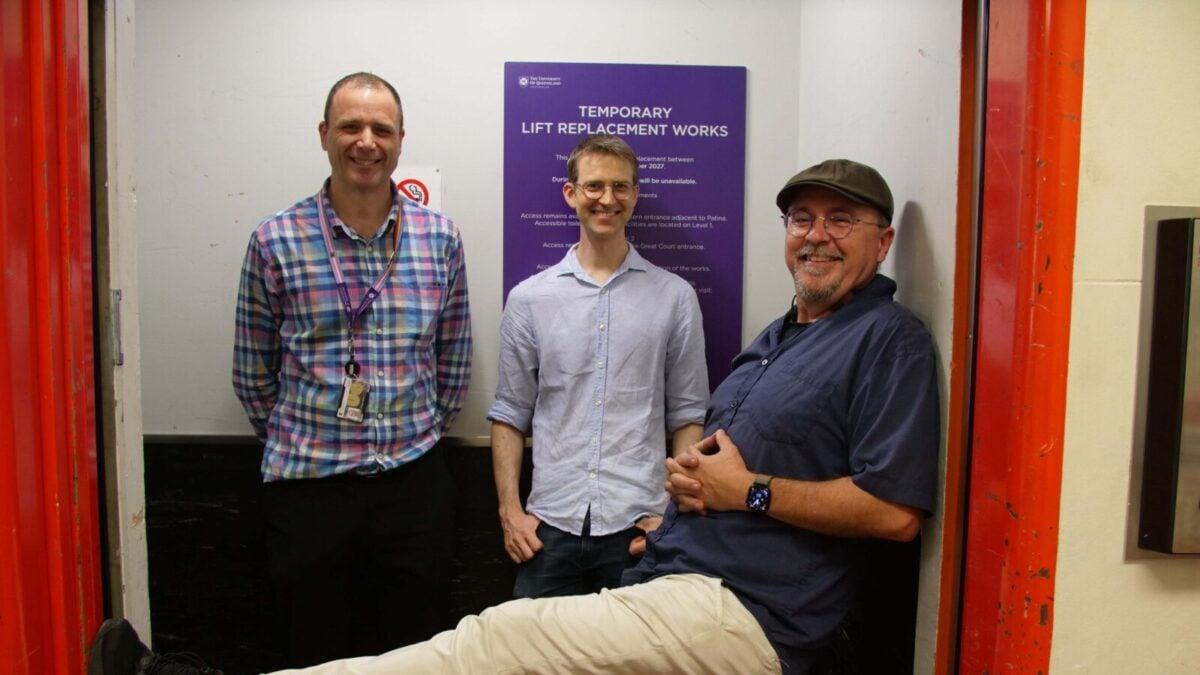
University of Queensland physicists used an elevator to send a gravity message through a brick wall to a bathroom in Australia. The experiment transmitted the word “gravity” about 70cm through the wall.
The message took nearly an hour to send. The researchers say their method is far from practical, but ordinary materials cannot simply block a gravitational signal as they can conventional wireless signals.
The proof-of-concept experiment used a slow-moving 1950s elevator in the university’s Parnell physics building. Its findings were published in Science Advances.
Elevator counterweight carried the message
The team placed a sensitive instrument called a gravimeter on the floor of a men’s bathroom beside the lift. It measured changes in the gravitational field as the elevator moved.
The device detected the position of the elevator’s 1.8-tonne counterweight as it moved between two floors. The two positions represented 0 and 1 in binary code, allowing the researchers to send their message one digit at a time.
They sent the word at a rate of one bit per minute. A bit is a single binary digit.
Study co-author Dr Charles Woffinden, of the university’s school of mathematics and physics, said gravitational signals differ from the electromagnetic signals used in modern wireless communication.
“Anyone who has lost phone reception in a tunnel or struggled with wifi through a solid wall will understand the appeal,” Woffinden said.
Faster sensors remain theoretical
Study co-author Professor Matthew Davis said, “At the moment, it’s very hard to imagine how it could be practically useful.”
Davis said NASA’s Voyager 1 spacecraft could “communicate with Earth at a faster data rate than our communication concept.” The spacecraft had just reached a distance of one light-day after 49 years of travel.
More sensitive quantum gravity sensors could theoretically extend the method’s range to 500 metres and make it 15 times faster, Davis said. Those sensors are still under development.
The elevator experiment grew out of work on a contactless weighbridge. That project would use quantum sensors to detect gravitational changes caused by a passing truck and determine its mass.
Other proposed communication methods use neutrinos or gravitational waves. The researchers said those approaches face difficulty generating a measurable signal.
Davis said such experiments could be unexpected fun: “It’s one of the great joys of science to have stuff like this happen.”
 Take the quizWhat Kind of Holiday Spender Are You? Take the Black Friday QuizStart →
- 1Joachim Klement to Sell Stocks After S&P 500 Signal

- 2Brent Crude Slides 4.05% as Rising US Stockpiles Weigh on Oil

- 3Stock Market Today: Nasdaq Rises at the Open While Dow Holds Near Flat

- 4UnitedHealth Shares Fall 10.2% Amid Medicare Audit Proposal

- 5Stock Market Today: Nasdaq and S&P 500 Futures Rise Ahead of Anthropic Debut

 Lifestyle · Food & HealthWhat Is Raynaud’s Syndrome? Why Fingers Turn White in the Cold
 Lifestyle · Food & Health4 Ways Walking After Meals Helps Your Body, Doctors Say
 Lifestyle · Food & Health4 Reasons to Eat Oatmeal, According to Nutrition Experts
 Lifestyle7 Signs Your Social Battery Is Running Low (and Why You Keep Cancelling Plans)