Diamond Study Shows How Electrons Restore Quantum Defects
Researchers have identified how electrons reach defects that make diamonds useful for quantum technology. Experiments and simulations show that electrons can pass directly from nearby nitrogen atoms, with the distance between them determining whether recovery takes nanoseconds or hours.
Researchers from Germany, Lithuania and the United States showed in a 2026 study how electrons find their way to diamond's quantum defects. Their findings explain how the defects recover after losing an electron needed for quantum devices.
The defects can act as highly sensitive magnetic sensors or as qubits, the basic units of quantum computers. They stop working in those roles while they wait for a replacement electron.
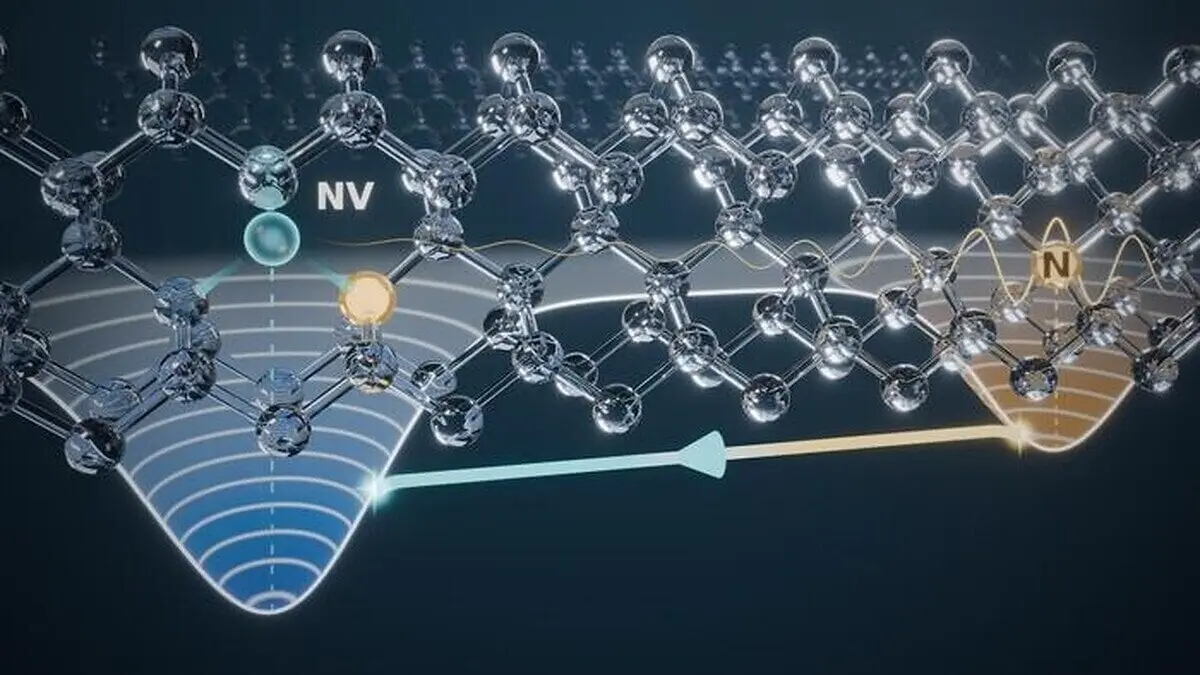
The study, published in Physical Review Letters, found that an electron can travel directly from a nearby nitrogen atom. It does so through tunneling, a quantum process that lets it pass through an energy barrier.
Nitrogen supplies the missing electron
The defect, called a nitrogen-vacancy center, consists of a nitrogen atom next to a gap where a carbon atom is missing. It needs an extra electron to work as a qubit or sensor.
Scientists already knew that nitrogen atoms elsewhere in the diamond supplied electrons. The puzzle was how an electron escaped nitrogen's strong grip.
Heat cannot free it. The team's simulations instead showed that tunneling moves the electron directly to the defect.
That transfer releases energy, which must be absorbed for the jump to occur. The simulations showed that a bond between nitrogen and a neighboring carbon atom reforms, releasing the energy as vibrations in the crystal.
“When the electron tunnels, it releases a large quantity of energy and the nitrogen atom turns out to be remarkably efficient at absorbing that particular amount,” said Lukas Razinkovas, head of the Electronic Structure Theory Laboratory at the Center for Physical Sciences and Technology in Vilnius.
Lasers track the recovery
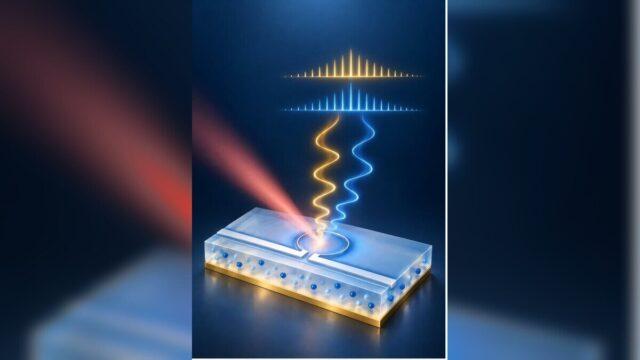
Ronald Ulbricht, a group leader at the Max Planck Institute for Polymer Research, developed an experiment to watch the slower recoveries. A pulsed red laser removed electrons from the centers, while a weak second laser passed through the diamond to a detector.
As the centers regained electrons, they absorbed that light again. The detector recorded their recovery.
“Following the signal from nanoseconds to seconds lets us separate the fast relaxation inside the NV center from the slow return of the charge, and that slow part is the tunneling,” Ulbricht said.
Centers in nitrogen-rich diamonds recovered faster. Heating crystals from near absolute zero to room temperature had no measurable effect, matching the tunneling model's prediction.
Distance changes recovery time
The team's calculations showed that a nitrogen atom within about 2 nanometers could restore a center in a few billionths of a second. Beyond 5 nanometers, recovery could take hours.
In a diamond with one nitrogen atom for every million carbon atoms, the model predicted that most centers would still lack their electrons after one hour.
The findings could help researchers stabilize the centers by placing nitrogen or other impurity atoms carefully. The paper was dedicated to co-author Audrius Alkauskas, who initiated the theoretical work and died before its completion.
 Take the quizWhat Kind of Holiday Spender Are You? Take the Black Friday QuizStart →
- 1Brent Crude Slides 4.05% as Rising US Stockpiles Weigh on Oil

- 2UnitedHealth Shares Fall 10.2% Amid Medicare Audit Proposal

- 3Stock Market Today: Nasdaq Rises at the Open While Dow Holds Near Flat

- 4Stock Market Today: Nasdaq and S&P 500 Futures Rise Ahead of Anthropic Debut

- 5PNB Shares Rally 5% as Bank Repeats Loan Growth Target

 Lifestyle · Food & HealthWhat Is Raynaud’s Syndrome? Why Fingers Turn White in the Cold
 Lifestyle · Food & Health4 Ways Walking After Meals Helps Your Body, Doctors Say
 Lifestyle · Food & Health4 Reasons to Eat Oatmeal, According to Nutrition Experts
 Lifestyle7 Signs Your Social Battery Is Running Low (and Why You Keep Cancelling Plans)