Interstellar Solar Sails Face Drag at 75% of Light Speed
A study by two Harbin Institute of Technology researchers finds that scattered light could resist a laser-driven sail at extreme speeds. The sail would still accelerate overall, but the effect could make it harder to propel small spacecraft toward other stars.
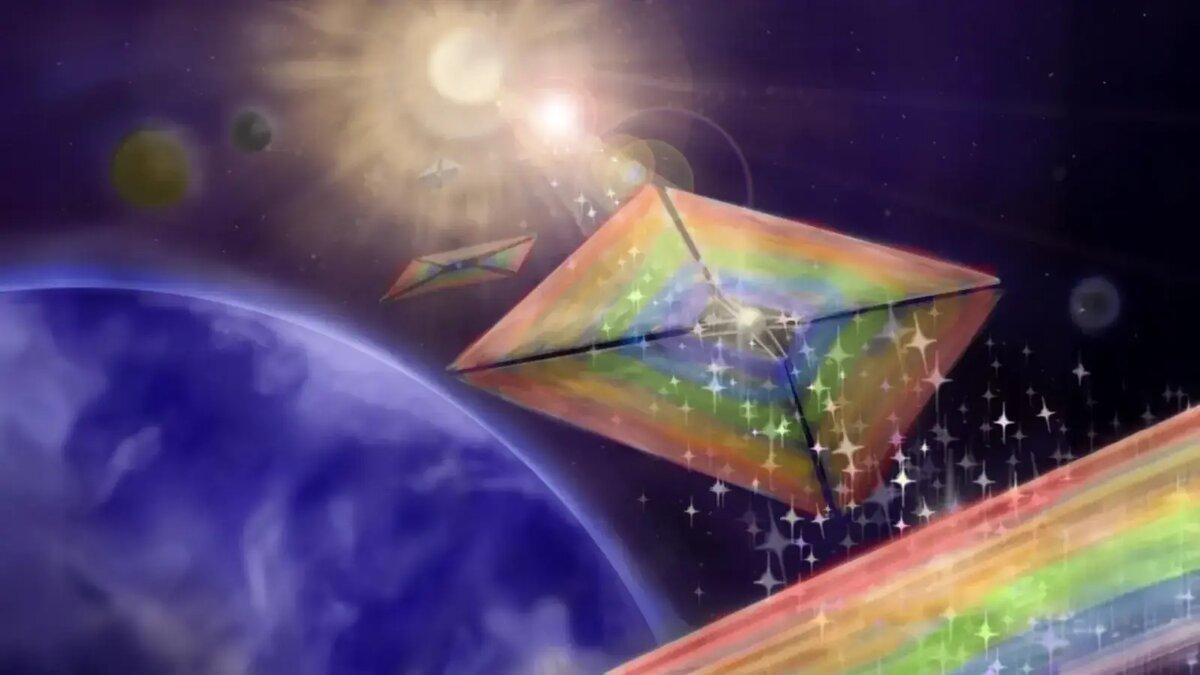
Researchers at the Harbin Institute of Technology have found that interstellar solar sails could face an unexpected drag near 75% of light speed. Chao Shen and Jiaze Li calculated that some scattered light would begin resisting a laser-driven sail, making further acceleration harder.
The finding does not mean a sail would stop. The laser would still produce a positive overall force, allowing the spacecraft to gain speed.
A solar sail is a lightweight, reflective surface propelled by light. Some proposed missions would use powerful lasers to push tiny probes toward other stars, rather than relying on conventional chemical rockets.
Shen and Li describe their calculations in a paper available on arXiv, dated June 2, 2026. They examined how light transfers momentum to a rapidly accelerating sail.
Scattered light can create drag
The researchers identified the drag effect at approximately 75% of the speed of light. At that speed, motion changes the apparent directions in which light travels, an effect known as relativistic light aberration.
From the perspective of an observer at rest on Earth, scattered light becomes concentrated toward the spacecraft’s forward direction. Emitting that light carries momentum, producing a recoil in the opposite direction.
That recoil turns one contribution from light into a drag force. It is the weakest of the three contributions the researchers examined.
Those contributions include incoming light striking the sail and light bouncing off it. The third comes from light absorbed by the sail and reemitted in random directions.
In the researchers’ breakdown, incoming light provides the strongest contribution, followed by reflected light. Scattered light provides the weakest.
Laser thrust weakens with speed
As a sail accelerates away from its laser, incoming light appears to decrease in frequency from the sail’s perspective. This redshift reduces how effectively the light transfers momentum, weakening all three contributions to thrust.
That makes each further gain in speed harder, even if the laser beam continues to strike the sail. The effect is related to the Doppler effect, which also changes the apparent pitch of a passing siren.
Breakthrough Starshot is among the concepts that have envisioned using powerful lasers to accelerate tiny spacecraft toward nearby stars.
Real sails need durable materials
The study treats the sail as an idealized mirror and focuses on forces produced by light. It does not model resistance from interstellar gas and dust or the heating caused by a powerful laser.
Too much absorbed energy could damage or melt a thin sail. A real sail would need to reflect laser light efficiently while remaining lightweight, durable and stable under extreme conditions.
Engineers are exploring specially designed materials, including metamaterials and photonic crystals, that interact with particular wavelengths of light. Controlling how those materials scatter light could potentially help a sail correct its orientation and stay aligned with the laser beam.
 Take the quizWhat Kind of Holiday Spender Are You? Take the Black Friday QuizStart →





 Markets · FintechHow to Calculate Compound Interest: Formula, Examples and the Rule of 72
 Lifestyle · Food & HealthNormal Blood Pressure Chart by Age: Healthy Ranges Explained
 Lifestyle · Food & HealthWhat Is Raynaud’s Syndrome? Why Fingers Turn White in the Cold
 Lifestyle · Food & Health4 Ways Walking After Meals Helps Your Body, Doctors Say