EV Battery Types in 2026: LFP, NMC, Solid-State, Sodium-Ion
Types of electric vehicle batteries in 2026 range from LFP to solid-state. Here’s what sets them apart in cost, range, and safety.
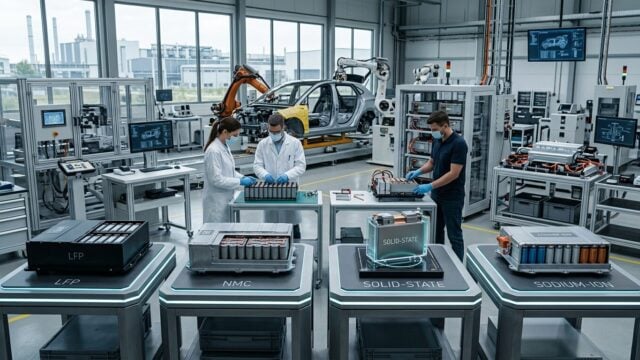
JAKARTA, JOURNALARTA.COM — Types of Electric Vehicle Batteries in 2026: LFP, NMC, Solid-State, Sodium-Ion are defining how much an electric car costs, how far it can go, and how safe it feels on the road. Batteries still account for as much as 40% of an EV’s total price, which is why manufacturers are pushing hard to cut cost without sacrificing range.
The competition is no longer theoretical. Four battery chemistries are already shaping the market: lithium iron phosphate, nickel manganese cobalt, solid-state, and sodium-ion. JournalArta reviewed figures and claims from the IEA, CATL, GM, Toyota, and other manufacturers to map where each technology stands in 2026.
Why battery chemistry matters now
For buyers, the battery pack is not just a technical detail. It decides whether an EV is a city car, a long-haul commuter, or a premium model with a high sticker price.
That tension explains the industry’s split. Some companies are chasing lower prices, others are chasing longer driving range, and a few are betting on batteries that are still years away from mass-market use. The result is a market where one chemistry can look ideal on paper, while another wins on cost, safety, or cold-weather performance.
Types of Electric Vehicle Batteries in 2026: LFP leads on cost
The most widely used option is lithium iron phosphate, or LFP. It uses lithium, iron, and phosphate, and leaves out nickel and cobalt. That gives it a major cost advantage. Low-end LFP cells are priced at around US$52 per kWh, compared with the 2025 average for lithium-ion batteries of US$74 per kWh.
LFP also has a safety edge. “LFP does not generate its own oxygen to feed a fire,” said a Telemetry analyst, referring to its lower thermal runaway risk. Its lifespan has improved by 40% over the past five years, which matters for fleets that rack up mileage fast.
There is a catch. LFP has lower energy density than NMC, so the driving range is usually shorter. It also performs less well in cold weather. Even so, it has become a standard choice in China, where three out of four EVs already used LFP in 2024. GM has also imported CATL cells for the Chevrolet Bolt 2027.
NMC still owns the long-range end of the market
Nickel manganese cobalt, or NMC, remains the chemistry of choice for many premium EVs and commercial trucks. Its main strength is clear: high energy density, which usually means longer range.
The trade-off shows up in both cost and risk. Nickel and cobalt push prices up, and cobalt continues to raise ethical mining concerns. NMC also carries a higher thermal runaway risk than LFP, which is one reason automakers keep balancing it against cheaper alternatives. For drivers who want more miles between charges, though, NMC still makes a strong case.
Solid-state is promising, but not ready for everyone
Solid-state batteries draw the most attention because they replace the liquid electrolyte with a solid one, often made from ceramic or sulfide materials. That design can deliver energy density around 50% higher than conventional lithium-ion cells, while reducing fire risk because there is no flammable liquid.
The headline numbers are eye-catching. Changan says its solid-state battery can reach 1,500 km under CLTC testing. Toyota is targeting 600 miles by the end of 2026. Samsung has also said its version could last up to 20 years with minimal degradation after more than 1,000 cycles.
Still, most of this technology remains in testing. Dongfeng expects to begin mass production of 350 Wh/kg solid-state cells in 2026. Toyota, Mercedes, and Stellantis are testing them with Factorial Energy. Full-scale production is expected in 2027 to 2028, once engineers solve problems such as dendrites, the microscopic lithium structures that can trigger short circuits.
Short sentence. Big hurdle.
Sodium-ion offers cheap materials and cold-weather strength
Sodium-ion batteries replace lithium with sodium, which is far more abundant and easier to source. That helps explain the average price of US$59 per kWh, which sits below the lithium-ion average. The chemistry also performs well in cold temperatures.
But sodium-ion batteries bring a shorter driving range because their energy density is lower. Charging performance in cold weather also remains limited. Even so, the technology is moving from lab work to real vehicles. CATL launched Naxtra, its sodium-ion battery for EVs, in 2026 with a target range of 600 km. Changan Nevo A06 became the world’s first mass-produced sodium-ion EV in February 2026.
What lower prices mean for drivers and fleets
The practical impact is easy to see. Falling battery prices can pull down EV sticker prices, which matters for first-time buyers, ride-hailing fleets, and companies that buy cars in bulk. When the battery pack is cheaper, the car has more room to compete with gasoline models on total ownership cost.
Price declines have been dramatic. Lithium-ion cells that cost US$568 per kWh in 2013 fell to US$74 per kWh in 2025. Battery life has also improved by 40%, and CATL says its AI-based battery management system can extend that by another 20%. That kind of progress affects resale value, charging habits, and how long a fleet can keep vehicles on the road before replacement.
Charging speed is also changing the buying equation. BYD says its Blade Battery 2.0 with Flash Charging can add energy in about five minutes, a claim that, if it scales, would narrow one of the biggest psychological gaps between EVs and petrol cars. For consumers, that is not a small detail. It shapes whether an EV feels convenient or merely impressive.
Which battery fits which use case
| Type | Best For | Notes |
|---|---|---|
| LFP | Affordable cars, ride-hailing | Safe and cheap, shorter range |
| NMC | Premium long-range cars | Expensive but long range |
| Solid-State | Future EVs in 2027+ | Higher range, safer, still scaling |
| Sodium-Ion | Low-cost EVs, electric scooters | Cheap, but not yet for long distances |
For storage outside cars, another chemistry is also gaining traction. Ore Energy in the Netherlands has developed an iron-air battery that can store power for 100 hours using iron, water, and air. It is cheap, but bulky, which makes it better suited to grid storage than to passenger vehicles.
The next few years will likely be a split screen: LFP and NMC handling today’s EV market, solid-state chasing the long-range premium segment, and sodium-ion trying to win on cost. “LFP does not generate its own oxygen to feed a fire,” the Telemetry analyst said, a line that still captures why safety keeps mattering as much as range.