Colombia Presidential Election: Cepeda vs De la Espriella
Colombia presidential election pits Ivan Cepeda against Abelardo de la Espriella as voters weigh security, cartels, and a tense runoff.
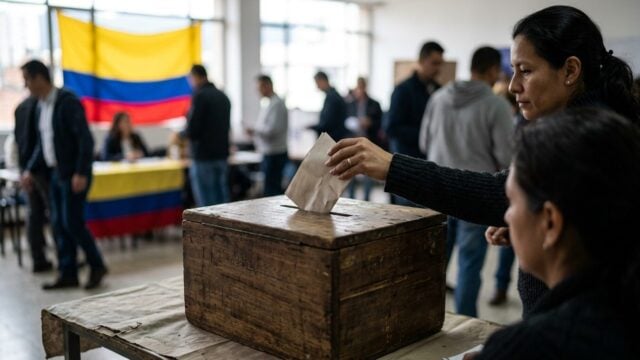
BOGOTA — Colombia’s presidential election: Ivan Cepeda and De la Espriella Battle for Votes as millions of voters headed to polling stations in a runoff defined by security fears, drug cartel violence and deep political polarization.
The vote will decide who takes charge at a moment of strain. Whoever wins inherits rising public debt, a health system under pressure and a gang war that has not eased.
Up to 41 million registered voters were eligible to choose between left-wing lawmaker Ivan Cepeda and hard-right criminal defense attorney Abelardo de la Espriella. Both moved into the runoff after finishing ahead of nine other contenders in the first round at the end of May.
Security sits at the center
Both campaigns have leaned hard into public anger over crime. But their answers could not be more different. One is pushing negotiation. The other is promising force.
De la Espriella, nicknamed “The Tiger,” has built his pitch around a tough-on-crime model inspired by Salvadoran President Nayib Bukele. He has also won backing from former U.S. President Donald Trump, a boost that gives his campaign extra weight with conservative voters.
He says he would hunt criminals without mercy and build 10 mega-prisons for gang members and drug cartel operatives. That message lands with voters exhausted by violence. Human rights groups, though, have warned against a crackdown that could widen abuses.
Cepeda is offering the opposite path. He wants to continue President Gustavo Petro’s effort to negotiate with armed groups in pursuit of broader civilian peace.
Short sentence. Very short.
That approach has drawn sharp criticism from opponents who say it moves too slowly and gives armed groups too much room. So far, only one small group of about 100 people has agreed to lay down arms and return to normal life.
Why the runoff feels different
The mood around this election is tense. Ordinary Colombians are not just choosing a president. They are weighing whether the country moves toward tougher enforcement or keeps betting on talks that have yet to deliver broad results.
John Manrique, a lawyer in Bogota, told AFP that the political split itself has become a source of fear. “Right now what worries me most is the polarization between us. There are two very extreme camps, and the potential for violence is deeply alarming,” he said.
Alex Vizcaino, a 59-year-old voter in the coastal city of Barranquilla, said the atmosphere feels unlike past elections. “This is the first election where you can feel a bit of fear. There is too much fanaticism out there,” he said after voting.
That anxiety has been sharpened by recent violence. Colombia recorded 14,780 homicides last year, the highest total since 2015, according to security authorities. One of the victims in that wave was conservative presidential hopeful Miguel Uribe, who was shot dead by a criminal gang.
The numbers matter because they shape how Colombians see the state. For many families, security is no longer an abstract campaign slogan. It is about whether their children can travel safely, whether businesses can stay open and whether armed groups keep extending their reach into daily life.
The first-round race was tight, and the divide remained clear heading into the runoff. According to the figures cited in the campaign, de la Espriella took 44% and Cepeda 41% in the first round.
| Candidate | Political leaning | First-round vote share |
|---|---|---|
| Abelardo de la Espriella | Right-wing | 44% |
| Ivan Cepeda | Left-wing | 41% |
Tension rose further after President Gustavo Petro questioned the legitimacy of the first-round results without strong evidence, following Cepeda’s narrow defeat after he had led in several official polls.
That dispute added another layer to an already volatile contest. It also fed doubts about trust in institutions at a time when Colombians are asking for clear answers, not more institutional noise.
The runoff comes exactly 10 years after Colombia signed its landmark peace agreement with the Revolutionary Armed Forces of Colombia, or FARC. But the optimism that followed has faded as rebel factions split apart and turned deeper toward cocaine trafficking.
The next government will face a blunt test from day one: whether it can lower killings without opening a new political wound. And with 41 million voters at the center of that decision, the margin could be narrow enough to keep the pressure on long after the ballots are counted.