Octopuses Can Squeeze Bodies Through Holes Smaller Than Their Eyes
Researchers documented how common octopuses change their movements to pass through openings of different sizes. They use a three-step sequence for wider gaps and add a separate step for tighter ones, moving their arms before squeezing the mantle through. The findings could help engineers design robots that carry sensors and tools into confined spaces.
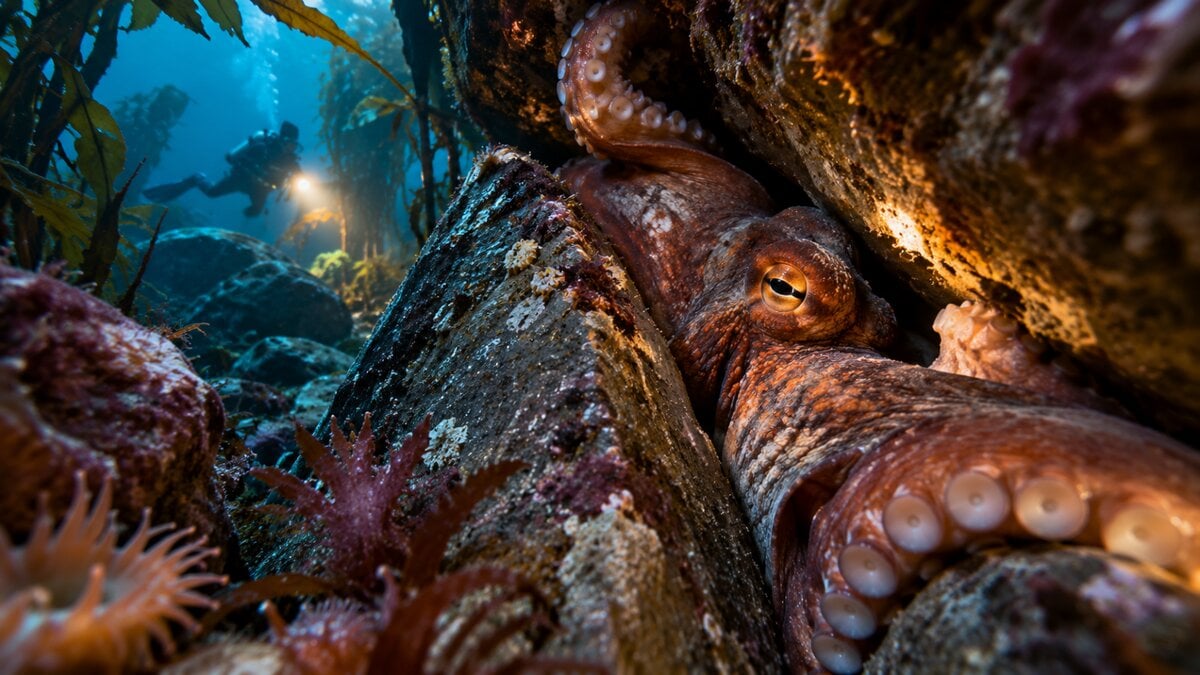
Researchers found that octopuses can squeeze bodies through openings smaller than the distance between their eyes by changing how they move their arms and mantle. A study of three sub-adult common octopuses, published in the Journal of Experimental Biology, documented a three-step method for wider gaps and a four-step sequence for narrower ones.
The shift matters beyond the animals’ escape skills. Researchers say understanding how octopuses negotiate tight spaces could help engineers design soft robots that carry more equipment into confined areas, including during search-and-rescue missions.
How do octopuses pass through tight openings?
For a relatively wide opening, the octopuses probed with their arms, moved several arms through, then used those arms against the partition to pull the rest of the body across. The researchers describe this as a three-step sequence.
When the opening narrowed, the animals separated the final movement into two stages: they moved the remaining arms through first, then pushed the mantle through. That made the maneuver a four-step process.
The researchers recorded the three animals as they passed through an adjustable opening. Their videos showed that the animals did not simply repeat one maneuver at different sizes. They changed the sequence as the gap became tighter.
“At the beginning, we expected the animals to use the same strategy. ... We were surprised when we found that the strategy changed,” said Wenci Xin, a researcher at the National University of Singapore’s Soft Robotics Lab and a study author.
What limits an octopus’s squeeze?
The octopus’s beak is its only rigid body part and has long been considered a key limit on how small a gap it can pass through. But Xin said the experiments suggest the size of the arms near the body may instead matter.
The animals’ flexible bodies have no rigid skeleton. Their arms can bend and elongate, while the mantle changes shape. The researchers also noted that the central nervous system sits within a stiff cartilage sheath, which can serve as a measure of the opening’s size.
Getting the head and mantle through is especially delicate because those parts contain vital organs, including three hearts, the digestive system and the central brain. The videos showed the octopuses carefully deforming the mantle as they moved through the smallest gaps.
Octopuses use tight spaces to escape and reach prey that other marine animals may not easily access. Michael Kuba, a biologist at the University of Naples Federico II and a study co-author, said the animals may use touch in their arms to assess an opening. “The idea is that the octopuses use the tactile sense on the arms to investigate the opening,” he said.
Why the movement could matter for robots
Robots designed to move through debris are often long and narrow so they can fit through small gaps, Xin said. An octopus-inspired design could instead use flexible arms equipped with sensors, tools or communication devices, allowing a robot to carry more equipment while navigating confined spaces.
That design would bring a trade-off. Xin said the arms would need to remain soft enough to squeeze through openings while also being strong and dexterous enough to bend, twist and stretch as they pull the rest of the robot forward.
The researchers also cautioned that the common octopus’s approach may not apply to every species. Octopuses living on sandy seabeds, or those with different body shapes and arm lengths, may use other strategies to pass through tight openings.