Xreal Aura pairs light glasses with limited Android XR apps
Xreal’s Aura headset offers a virtual display in lightweight glasses, but its Android XR software has a limited app selection. The headset starts at $1,279 and is on sale for $1,099 through December.
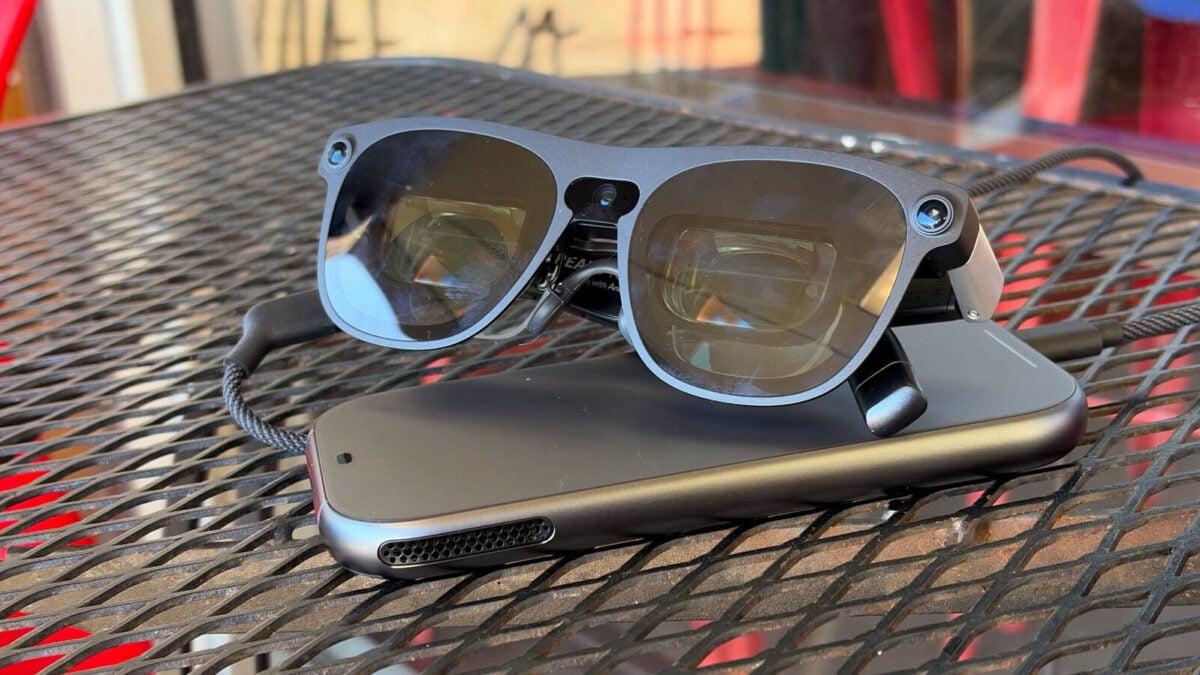
Xreal is launching the Aura headset with lightweight glasses and Android XR software, though a review found its app selection and controls lacking. The device starts at $1,279 and is on sale for $1,099 through December.
The Aura is aimed mainly at virtual reality developers. It costs less than Samsung’s $1,800 Galaxy XR headset and Apple’s $3,699 Vision Pro.
The glasses connect by cable to a Compute Puck, which contains the hardware needed to run Android XR. The frames have cameras for sensing their surroundings, tracking fingers and capturing photos and video.
Transparent lenses let wearers see the world around them. They can also darken the display to block out their surroundings.
Light frames and a wired puck
The frames weigh 95 grams (0.2 pounds) on their own. Their small OLED screens have a resolution of 1,920 by 1,200 and reach up to 1,058 nits of brightness.
The glasses support up to 120Hz with external devices, while the Android XR interface runs at 72Hz. The Aura has a 70-degree field of view, narrower than dedicated virtual reality headsets.
The Compute Puck uses a Qualcomm Snapdragon Reality Elite chip and Xreal’s X1S spatial processor. Configurations offer either 12GB or 16GB of memory and either 256GB or 512GB of storage.
It has two USB-C ports: one connects the glasses, and the other handles charging or a separate device. Its top surface also works as a trackpad.
Video from a device connected to the puck appears in a resizable Android XR window. The glasses can also connect directly to computers and other devices as a virtual display.
Software limits the experience
A review found the glasses comfortable and well suited to movies and use as a large virtual monitor. It also found frequent app crashes and slow responses to finger pointing and pinching.
The headset lacks eye tracking, and repeated pointing became tiring during navigation. The reviewer preferred the puck’s trackpad.
Entertainment apps include HBO Max and Prime Video, but not Disney+ or Netflix. Users must access other streaming services through the Chrome browser.
Connecting an external device through the puck also made text slightly blurry in the review. A direct connection to the glasses produced a sharper view.
During a battery test, the charge fell from full to 40 percent after 90 minutes of video, web browsing and Google Maps use. It lasted another 95 minutes before draining completely.
Xreal recommends keeping the puck out of pockets and other enclosed spaces during demanding use or fast charging. The headset comes with a lanyard and belt holster.
 Take the quizWhat Kind of Holiday Spender Are You? Take the Black Friday QuizStart →
- 1U.S. Emergency Alert Test Nov. 17 Is Not a Power Outage

- 2Gold Silver Price November: Futures Rise Near Yearly Lows

- 3Michael Clarke Says Sandpapergate Scars Drew Steve Smith to New York

- 42027 NFL Mock Draft Puts Ohio State’s Jeremiah Smith at No. 1

- 5GTA 6 New Zealand Time Trick Is Not Guaranteed to Work

 Lifestyle · Food & Health4 Reasons to Eat Oatmeal, According to Nutrition Experts
 Lifestyle7 Signs Your Social Battery Is Running Low (and Why You Keep Cancelling Plans)
 Lifestyle · Food & HealthThanksgiving Food Safety: How Long Leftovers Last and the Safe Turkey Temperature
 Lifestyle7 Quiet Habits of Emotionally Intelligent People, According to Psychologists