GLP-1 Use Rises, but Study Finds Growing Access Gaps
A Boston University study found that prescription fills for two weight-management drugs rose among eligible US patients with commercial insurance. Access gaps widened, with lower rates among Black and Hispanic patients and those whose providers practiced in lower-income neighborhoods.
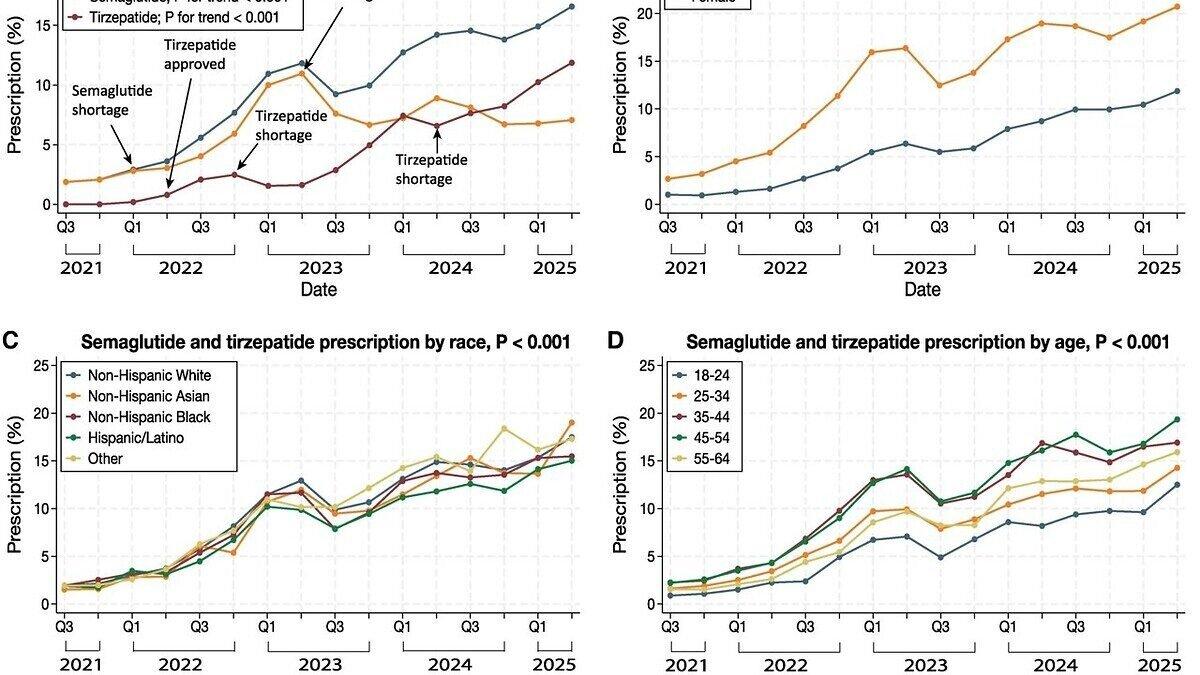
Boston University researchers found widening gaps in access to GLP-1 weight-loss drugs across the United States, despite soaring demand. Among eligible patients with commercial insurance, prescription fills rose from 1.9% in 2021 to 16.6% in 2025, the study found.
The researchers examined people with overweight or obesity who did not have type 2 diabetes. They tracked prescriptions filled within six months of patients becoming eligible for treatment.
The study covered semaglutide, sold as Ozempic and Wegovy, and tirzepatide, sold as Mounjaro and Zepbound. It was published in Health Affairs Scholar.
Prescription gaps widened over time
Prescription rates were lower among men, Black or Hispanic patients, and patients ages 18–34 or 55–64. Rates were also lower among patients in a lower body mass index category.
Patients whose providers practiced in neighborhoods with lower socioeconomic status also had lower prescription rates. Researchers measured neighborhood status using education levels in the provider’s ZIP code.
The gaps widened over time and were especially pronounced in 2024 and 2025. The Food and Drug Administration approved semaglutide for chronic weight management in 2021 and tirzepatide in 2023.
Dr. Minh Trung Le, the study’s lead author, said patients at clinics in lower socioeconomic neighborhoods faced about 35% lower odds of being prescribed the drugs in 2024–2025. Early in the study period, the gap was about 15%, Le said.
Le said insurance coverage alone does not close the gap. He called for changes to drug benefits and support for clinics handling prior-authorization paperwork.
Study examined commercially insured patients
The researchers analyzed information on 512,389 eligible patients ages 18–64. They used a national medical claims database containing closed claims for more than 175 million patients.
The analysis excluded patients covered by Medicaid or Medicare, people without insurance and prescriptions obtained through direct-to-consumer channels. The researchers noted that the vast majority of eligible patients still did not receive the drugs for weight management.
GLP-1 stands for glucagon-like peptide-1. The drugs mimic a natural hormone that helps regulate insulin, blood sugar, appetite and digestion.
Dr. Andrew Stokes, the study’s senior author and an associate professor of global health at Boston University School of Public Health, said insurance coverage is easier to obtain for people with diabetes.
“We have better treatments for obesity than ever, but access to them hasn't caught up,” Stokes said.
Le said drug benefit design matters, including prior authorization, step therapy and out-of-pocket costs. Step therapy can require patients to try other treatments before an insurer covers a drug.
 Take the quizWhat Kind of Holiday Spender Are You? Take the Black Friday QuizStart →





 Markets · FintechHow to Calculate Compound Interest: Formula, Examples and the Rule of 72
 Lifestyle · Food & HealthNormal Blood Pressure Chart by Age: Healthy Ranges Explained
 Lifestyle · Food & HealthWhat Is Raynaud’s Syndrome? Why Fingers Turn White in the Cold
 Lifestyle · Food & Health4 Ways Walking After Meals Helps Your Body, Doctors Say