Taiwan Resistance Plan Extends to Japan and the Philippines
Taiwan’s island geography leaves resistance forces with little room to retreat if China invades. A proposed area complex would shift recruitment, intelligence…
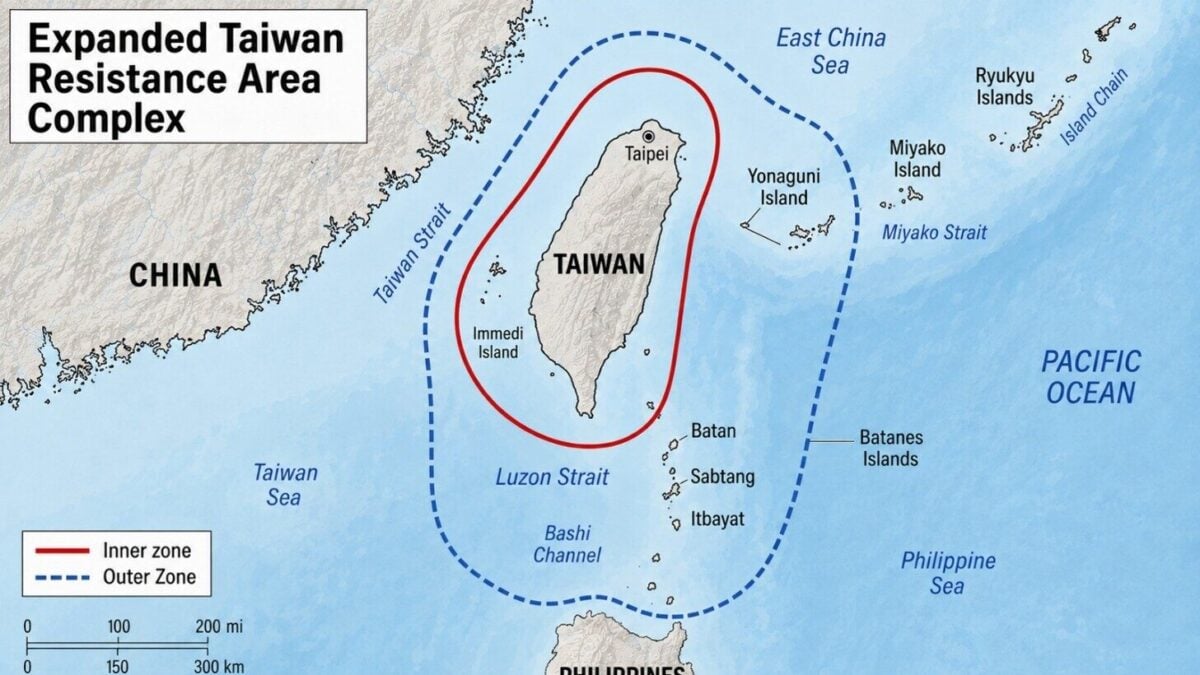
Taiwan’s resistance planners could extend support networks to Japan and the Philippines to address the island’s lack of strategic depth in a Chinese invasion. The proposal adapts a US military doctrine built around a resistance area complex, shifting some functions beyond Taiwan’s shores.
The geographic constraint is stark: Taiwan has no land border or neighboring state where surviving forces could retreat. If Chinese forces landed, resistance units would be compressed into close proximity with occupying forces, with little space to regroup or operate behind enemy lines.
That leaves planners with a difficult problem. Taiwan’s isolation could also hinder the arrival of weapons, medical supplies, foreign fighters and communications equipment, even if outside governments were willing to provide them.
Why expand Taiwan’s resistance area?
The concept draws on US Army Special Forces unconventional warfare doctrine, including Field Manual 3-05.201. It describes an “area complex” as a dispersed, clandestine network intended to provide a resistance movement with security, flexibility and control.
Such a complex can include communications, logistics, medical facilities, supply caches, training areas and escape routes. The doctrine also divides the network into inner and outer security zones around a resistance area command.
On a connected landmass, an outer zone can absorb pressure before it reaches command cells. It can also provide early warning, gather intelligence, recruit and train fighters, and develop civilian support. Taiwan can organize an inner zone, but the doctrine’s usual outer zone cannot be placed on neighboring land because there is none.
Geography changes the plan.
The proposal is to move some of those functions across the water, rather than abandon them. Recruitment and volunteer vetting, intelligence gathering on Chinese naval movements through the straits, and logistics and communications support could take place at a distance from the resistance command cells they serve.
Why Japan and the Philippines?
The analysis identifies Japan and the Philippines as the closest practical locations for the missing outer zone of Taiwan’s resistance area complex. Their proximity could make them extensions of the network, while Guam, Palau, Okinawa and other locations may also have roles.
The distinction matters for the plan: the immediate requirement is not simply to find places that could support Taiwan, but to develop locations close enough to function as extensions of its resistance architecture. That would shift parts of organizing and support beyond the island, where people and facilities would not be concentrated alongside occupying forces.
For Taiwan, the approach addresses a vulnerability that conventional doctrine does not resolve on its own. A resistance network would need to preserve links between command cells on the island and support functions outside it, despite the separation imposed by geography.
The proposal does not remove the risks of isolation or occupation. It reframes the area complex around Taiwan’s position: an inner zone on the island, with nearby locations in Japan and the Philippines potentially carrying some of the work normally assigned to an outer zone.
The analysis names Japan and the Philippines as the immediate locations for that proposed extension.