Strong Earthquake Jolts Sumba Island, Damaging Schools and Homes
A powerful earthquake hit Kodi, Sumba, on Sunday morning. Authorities report structural damage to schools and homes; one person sustained injuries.
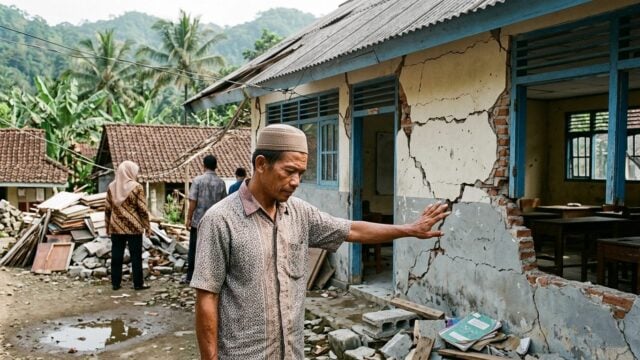
KODI — A significant earthquake struck the Kodi region of Southwest Sumba, East Nusa Tenggara, on Sunday morning, October 4, 2026, causing widespread alarm and structural damage to local infrastructure. The tremor, which occurred at 5:55 a.m. local time (WIB), forced residents to flee their homes as the ground shook with an intensity ranging from IV to VI on the Modified Mercalli Intensity (MMI) scale.
Indonesia's Meteorology, Climatology, and Geophysical Agency (BMKG) pinpointed the epicenter 14 kilometers southwest of Kodi, situated at 9.70 South Latitude and 118.92 East Longitude. While the event caused structural failures in buildings, officials confirmed that the earthquake did not trigger a tsunami warning.
Infrastructure Damage and Casualties
The impact was most concentrated in the Perokonda area. Teguh Rahayu, the Director of Engineering Seismology, Potential Geophysics, and Time at the BMKG, confirmed that the damage includes a local Islamic elementary school and at least two residential homes. One individual sustained minor injuries during the incident.
"The damage is concentrated in the Perokonda region, specifically at an Islamic elementary school and two private residences," Rahayu stated. The structural damage to the school has raised immediate concerns regarding the safety of students and the continuity of the local academic calendar.
Understanding the Seismic Intensity
BMKG officials explained that the varying levels of damage were dictated by the earthquake's MMI scale. In areas experiencing IV MMI, residents reported rattling windows, doors, and loose household objects—a common occurrence for those on the periphery of the epicenter. Closer to the focus, VI MMI intensity caused more severe disturbances, leading to cracked plaster and structural stress on buildings.
"The earthquake was felt at levels between IV and VI MMI," Rahayu added, noting the intensity forced many residents to scramble for safety during the early morning hours. The tremor, occurring in a notoriously active tectonic zone, serves as a stark reminder of the region’s seismic vulnerability.
Disaster Preparedness and Regional Risks
Southwest Sumba remains a high-risk area for seismic activity. BMKG has released comprehensive technical data to assist local disaster mitigation teams in their recovery efforts and in assessing the stability of damaged structures. Experts emphasize that the combination of shallow focus depth and local building standards often exacerbates the impact of moderate-magnitude quakes.
Regional authorities are being urged to accelerate disaster resilience programs, including public education campaigns and the enforcement of earthquake-resistant building codes. For the residents of Kodi, the focus remains on immediate repairs and managing the psychological toll on families, particularly children, who were caught by surprise while sleeping.